
GOGO: ARE WE THERE YET?
The in-flight flight tracker I built 0 → 1 at the dawn of airborne Wi-Fi, by finding a local position file that didn't need the air-to-ground connection. So it answered the passenger's #1 question, and kept the ad inventory selling, even when the Wi-Fi dropped.
0 → 1
Built the tracker from scratch
Offline-proof
Ran on a local feed, not the ATG link
Are we
there yet?
The #1 passenger question, answered
Ads stayed live
Sponsorship inventory through outages
Shipped an in-flight tracker 0→1 that kept earning when the Wi-Fi dropped.
01 · The Context
In-flight internet was brand new. Gogo's air-to-ground (ATG) network, cell towers on the ground beaming up to the plane, was the product, and in the early days it was touch-and-go: it dropped, it lagged, it cut out between cells and over water. The headline feature was the part you couldn't count on.
Meanwhile, every passenger on every flight was asking the same thing, the question cabin crews hear most: are we there yet? Where are we, how much longer. The obvious way to answer it (show live flight progress on a map) looked like it required the connection. Which was exactly the part that kept failing.
02 · The Discovery, a Local Position File
Digging through Gogo's onboard software, I found something nobody was using: a local position file carrying the plane's position and flight data, written on the onboard server: separate from the aircraft's avionics, and separate from the air-to-ground link. The plane always knew where it was. That data was already onboard. It didn't need the internet to exist.
Which meant a flight tracker could read it locally and render progress whether or not the ATG connection was up. The reliability problem had a side door.
03 · The Tracker, 0 → 1
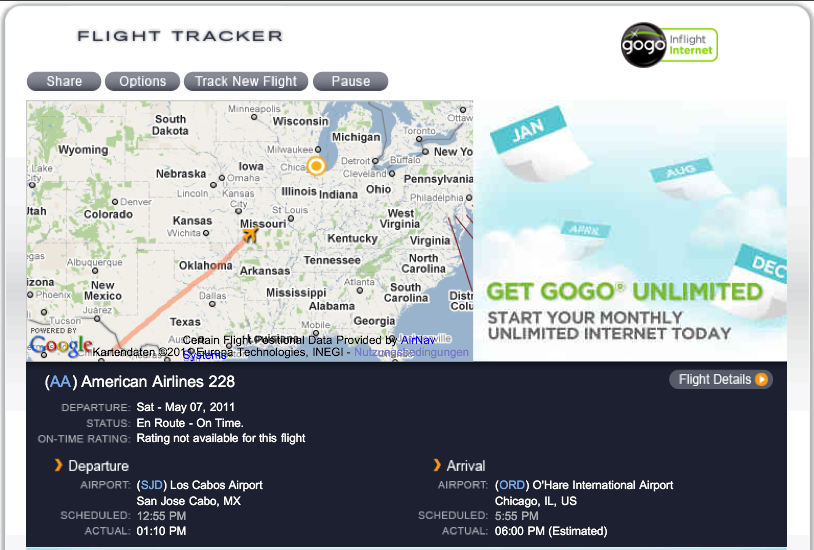
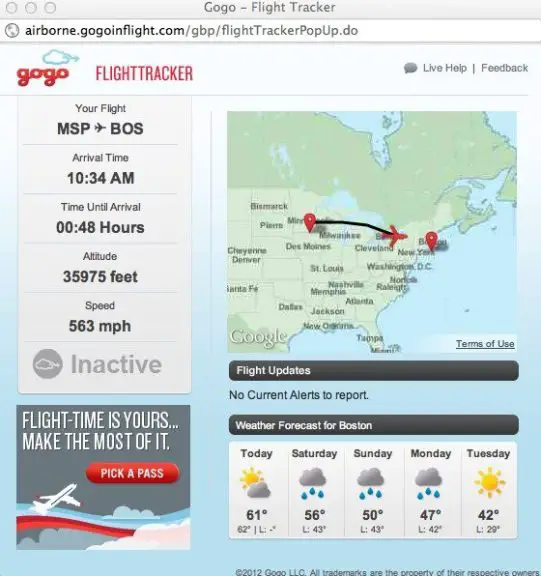
I designed and shipped the in-flight flight tracker from scratch: a map with the route, the plane's position along it, departure and arrival airports, scheduled vs. actual times, and a live ETA, the passenger's "are we there yet?" answered at a glance. Because it ran off the local feed, it kept working when the connection didn't. On a product that was still finding its footing, this was the one page guaranteed to load.
04 · Why It Mattered
That reliability did two jobs at once.
For passengers, it answered the single most-asked question on any flight, dependably. A real service win on a product whose marquee feature was still flaky.
For the business, it kept the lights on. The tracker page always rendered, so it always had ad and sponsorship inventory to sell, even during a connectivity outage, when nothing else on Gogo would load. An always-on page in front of a captive audience is exactly what sponsors pay for. The tracker helped land sponsorship deals: it turned a reliability problem into a revenue surface.
05 · What It Proves
The headline feature was broken half the time. Instead of waiting for the network to get better, I found the data that was already onboard and shipped the thing passengers actually wanted, then turned that reliability into something the business could sell. The instinct underneath it (the useful data is usually already there; go find it, and ship) is the same one behind the FourKites trust dashboards a decade later and the Thios single-source-of-truth work fifteen years later. The technologies changed. The instinct didn't.
Gallery
LET'S TALK
Working on something like this, or hiring for it?