
HERE: REAL-TIME TRAFFIC, BEFORE LIVE TRAFFIC
A convention demo putting HERE's near-real-time traffic in front of automakers, a wall of screens that grew 3 → 6 → 9 as we packed in more data, more depth, and more history. Powered by DEMPSY, a beat before live traffic (and the Storm-era stream stack) reset the field.
3 → 9
Screens · more data each time
Near real-time
Traffic + probe feed
Auto OEMs
The convention audience
Team of 3
PM · demo · fixer · UI vision
01 · The Context
HERE, Nokia's mapping arm, sold maps and traffic data to the world's automakers. The asset was a firehose of GPS probe data streaming in from connected vehicles, everywhere, continuously. But on a convention floor, in front of OEM buyers, a firehose of telematics is abstract. You can't sell a spreadsheet.
The job was to make the data undeniable: to turn an invisible advantage into something an automaker exec could stand in front of and instantly believe: the world is moving, we can see all of it, right now, and we can hand you that.
02 · The Wall
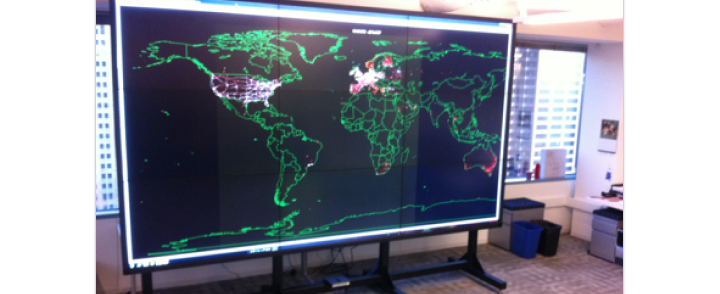
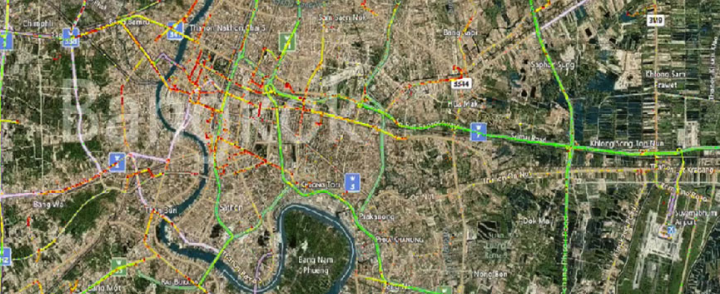
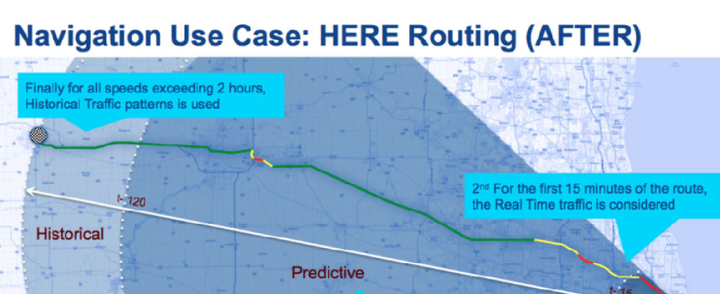
The answer was physical: a wall of large screens running a near-real-time traffic and probe feed, set up at conventions as a live demo of what HERE's data could do. It started with three screens. As the team tuned the pipeline to pull in more data, more depth, and more history (not just where traffic is now, but how it moves and how it has moved), the wall grew to six, then nine. Each expansion existed to show more.
The whole thing was a team of three. I didn't write the shell script that drove it, but I product-marketing-managed it, ran the demo on the convention floor, was the fixer when it broke mid-show, and was the one envisioning the UI: what the screens should actually show, and how to make nine of them read as one living map instead of nine busy ones.
03 · Under the Hood, DEMPSY
The wall did double duty: it was also a showcase for DEMPSY, the open-source real-time stream-processing engine HERE had built as a real-time alternative to batch Hadoop. The live feed was the proof DEMPSY worked: billions of probe events, processed and rendered as motion, in near real time. The demo sold two stories at once: HERE's traffic data, and the engine that could move it fast enough to feel live.
04 · Why It Mattered, and the Twist
For its moment, this was genuinely ahead. Showing real-time global traffic as a living thing in 2012–2014 was a "wow," not a default. The wall previewed the live-traffic era a beat before it arrived.
Then the field moved, twice. Within a couple of years Google, Waze, and Android made live traffic ubiquitous, and Storm, and the ecosystem that followed it, won the stream-processing world DEMPSY was built for. Both bets this demo championed were early, right, and ultimately overtaken.
That's not a footnote. It's the lesson. Being early is its own kind of being right, and the instinct underneath both bets (make real-time data legible enough to feel) outlasted the specific technologies by a decade.
05 · What It Proves
It started here, on a convention floor, with three people, a shell script, and nine screens, betting that the right visualization could make people feel the data before the rest of the world caught up. That rig is a museum piece now; the bet underneath it is the one I've kept making ever since.
Gallery
LET'S TALK
Working on something like this, or hiring for it?