
THIS TRIP, BTW, DESIGNED FOR THE AGENT ERA
A shareable trip map an AI can build and a human can open: no account to make one, no account to open it, and nothing invented along the way.
0
Accounts to build or open
0
Ads, trackers, or profiling
1
Third party, Stripe (so you're the customer)
$2.50–$10
One-time · 3 keep-tiers
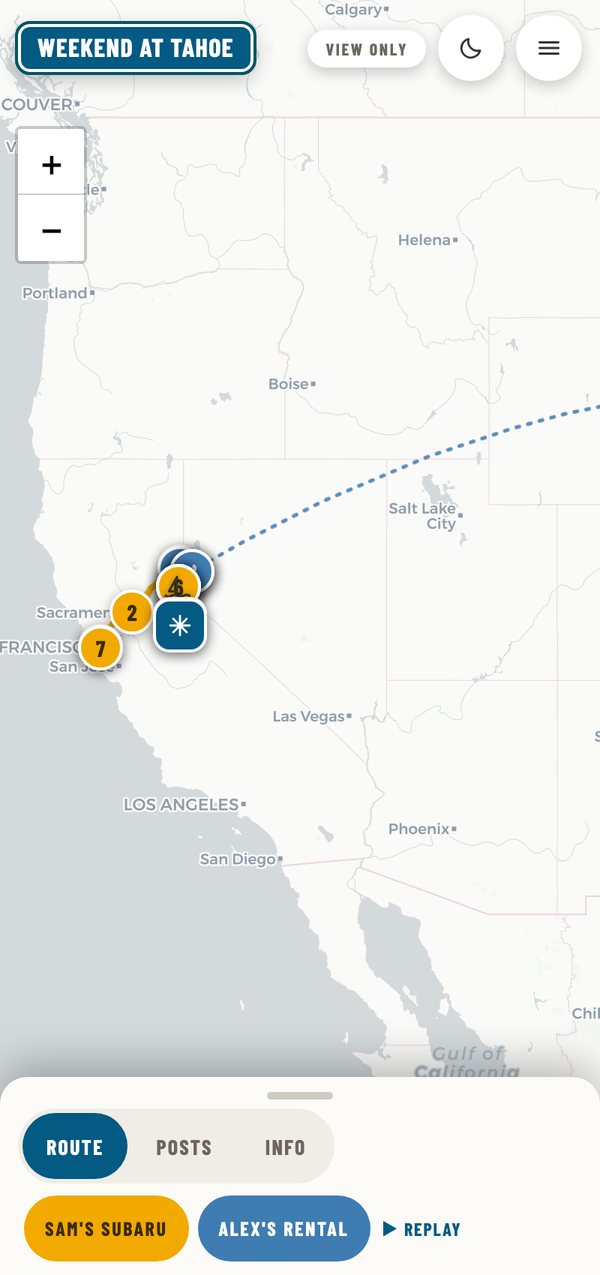
Built and shipped solo: a private trip map an AI assistant can hand a traveler as a link, already on the map, no sign-up, nothing fabricated. In beta, on real trips.
The Strategic Problem
Trip planning is scattered across apps, group chats, and screenshots, and every tool wants an account before it does anything useful. Two shifts made that model wrong at the same time.
People won't install an app and create an account to add one stop to a friend's trip. And AI assistants, now a real front door to travel, can't make accounts or enter card details at all. Most are barred from it, which quietly puts nearly every travel tool out of their reach.
The opening was a trip that needs nobody to hold an account: not the traveler, their crew, or the agent.
Why This Was Hard
- Two very different users, one artifact. A grandparent adding a photo and an AI building a 12-leg itinerary have to meet on the same map, neither of them onboarded.
- Privacy as architecture, not a policy page. "We don't harvest you" only means something if the system can't, not if it promises not to.
- Trust in data nobody checked. A map lends authority to whatever sits on it. An agent that guesses a flight time, or a geocoder that picks the wrong Springfield, becomes the product's lie in the user's eyes.
- A business model that doesn't betray the premise. The default free tier is funded by data. Refusing it means charging money for something people expect to get free.
The Calls
The fast paths were the ones that quietly break the premise:
- Ruled out, accounts to participate. The default move, and it kills the share loop and locks agents out entirely.
- Ruled out, an ad/analytics free tier. It makes the user the product, which is the exact thing this is built to sell against.
- Ruled out, guessing coordinates or flights from a name. A wrong guess doesn't read as a data limitation. It reads as the product lying.
The bet. The account is the enemy of adoption, and privacy is the product. Building a trip is free and asks for nothing. The trip data rides in the URL fragment, the part of a link a browser never sends to a server, so a plan only reaches the company if the traveler chooses to keep it, from $2.50. You pay, so you're the customer, never the product.
What I Got Wrong First
The first draft assumed an account, because every product has one. Then it clicked: the account isn't a feature. It's a sales funnel, and an agent can't walk a funnel. Agent Experience (AX) requires no account. That single reframe rewrote the entire product; everything below follows from it.
Designed for the Agent Era
This is the part no enterprise case study has: a product shaped, top to bottom, by what an AI agent can and can't do.
The constraint became the design
Because an agent can't make an account or pay, the whole product is built to need neither. An assistant base64url-encodes a small trip JSON into a link fragment (/new#d=…) and hands it over, already drawn on a real map, on real roads, with no key, no account, no card.
"We record; we don't verify"
A written rule for the agents that build these trips: whatever you hand over is drawn exactly as given. No flight, road, or date is checked. If you're not certain a detail is real, tell your traveler rather than letting the map lend it credibility, and never invent a flight number. This is the FourKites instinct (surface confidence, don't fake it) and the Deere trust instinct, ported to the agent era.
The whole agent-facing layer, not just a webpage
I built the raw #d= link format, a hosted MCP endpoint (/mcp), a one-file, zero-dependency MCP server that self-tests offline, and an installable Skill (script plus doc). The server and Skill are checked byte-for-byte so they can't drift, and published with checksums so an agent can verify what it got. Same single-source-of-truth, drift-audit instinct as my Thios design-system work.
Honest about the middlemen
The agent docs go one step further: they tell agents that proxy gateways (Smithery, for one) can read a trip in transit, and how to route around them. Designing the honest path, not just the happy one.
This portfolio speaks Markdown, too
Same instinct, turned on this very site: send Accept: text/markdown and every anchor page here, this homepage and the Deere, FourKites, and Thios case studies, answers with a clean Markdown rendering, nav and chrome and boilerplate stripped, so an agent reading my work gets the substance instead of a DOM to scrape. Same URL, negotiated on the Accept header (with Vary: Accept so caches don't cross the wires), or explicitly at /index.md. View this site as Markdown →
Why Charge, the Pricing Is the Ethics
No free tier means no reason to harvest or profile. The three one-time keep-tiers trade money for time and memory: a trip that deletes itself in a year, five years, or ten, with photos and then video pinned where they happened. The only third party the product touches is Stripe, to take the payment. There is nothing to sell about you, because you already paid.
What It Proves
The same operator behind Deere's adoption work and FourKites' trust-in-uncertain-data control tower, now in consumer and agent-native form: adoption without an account, and a map that refuses to fabricate what it can't verify. Different industry, the same two instincts.
It is early, an open beta anyone can open, in use on real trips (my family used it live on a road trip; a canoe trip with friends is in planning). The point of the page is the judgment and the range, not a traction number.
The Product
LET'S TALK
Building consumer or agent-native products, or hiring for it?